State figures first, national guides second
Radon Mitigation Cost in Denver, by House Type
Radon mitigation cost in Denver comes down to the house more than the test number: how many foundation types sit under it, what is beneath the slab, and how the pipe reaches the roof. Colorado's health department publishes its own ranges, so they lead the table below; two national guides follow for comparison.
CDPHE puts a traditional radon system on an existing single-family home at about $1,300–$3,000, and adding a fan to a built-in passive pipe at about $500. Nationally, Thumbtack (2026) reports $748–$1,529, with most people paying about $1,071.
Radon mitigation cost in Denver, by situation
| Situation | Typical range | Source | What moves it in a Denver house |
|---|---|---|---|
| Traditional system, existing single-family home | $1,300–$3,000 | CDPHE Radon FAQ | Suction points, pipe route, finished space in the way |
| Colorado system without hard design problems | About $1,000–$2,000 | CDPHE testing and mitigation page | One suction point under a clean basement slab |
| Typical system, national | $748–$1,529 (most pay about $1,071) | Thumbtack, 2026 | Basement-only homes cost less than crawl space homes |
| Active sub-slab suction (basement or slab) | $800–$2,500 | Bob Vila, 2022 | How freely air moves in the fill under the floor |
| Crawl space sub-membrane system | $800–$3,000 | Bob Vila, 2022 | Floor area, piers and headroom in the crawl |
| Block-wall suction, added to sub-slab | $1,500–$3,000 | Bob Vila, 2022 | Hollow concrete block foundation walls |
| Fan added to a built-in passive pipe | About $500 | CDPHE Radon FAQ | Attic access and a power source near the pipe |
| Replacement radon fan | $100–$300 or more | Bob Vila, 2022 | Fan model and how hard it is to reach |
| Test by a licensed measurement professional | Around $150 | CDPHE Radon FAQ | Continuous monitor or other device; sale deadlines |
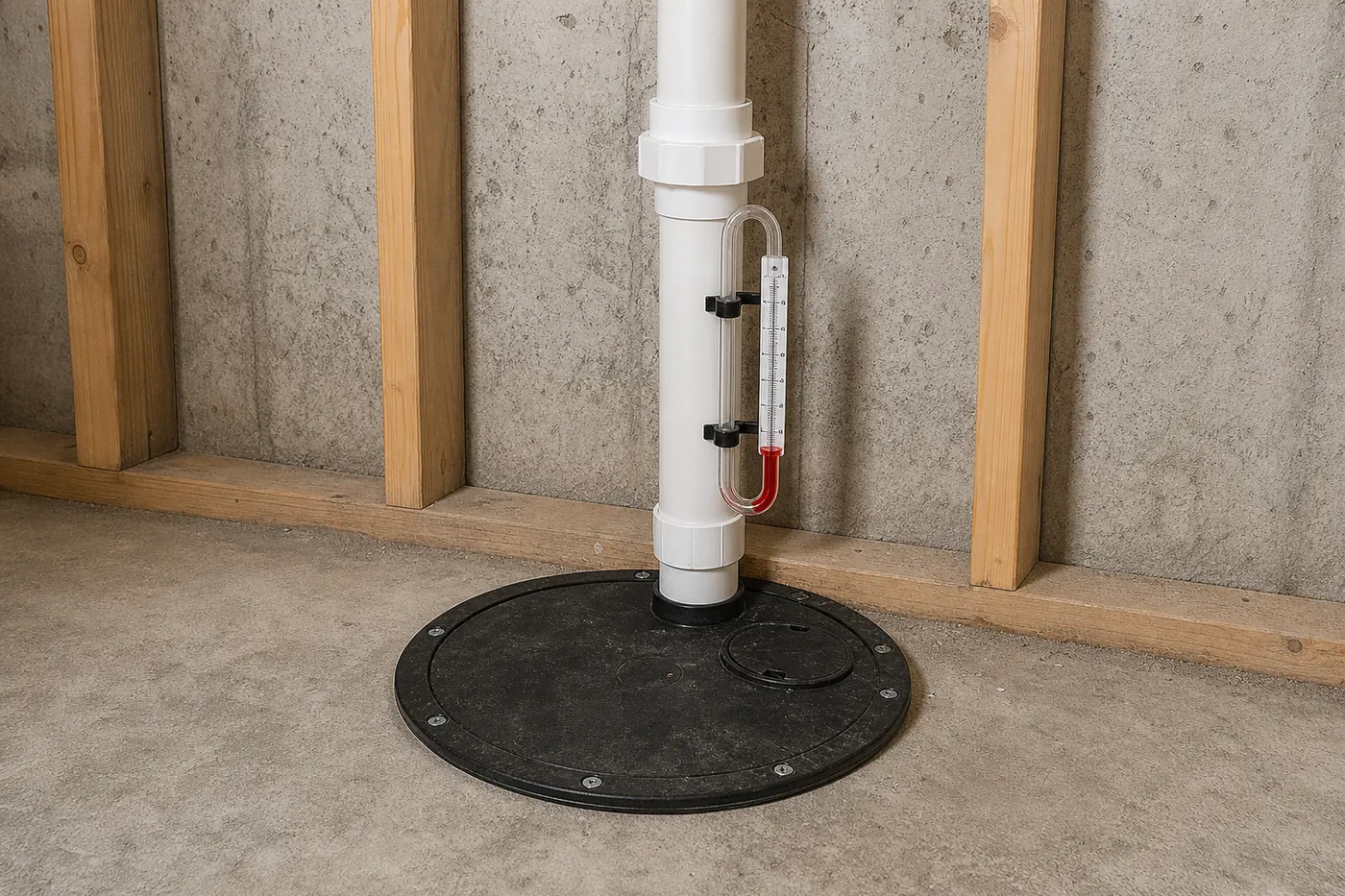
What moves radon mitigation cost on a Denver house?
- More than one foundation. EPA notes that a basement under part of a house and a slab or crawl space under the rest is common, and that it can take a combination of methods. Each added area usually means another suction point or a sealed sheet.
- The ground under the slab. EPA says the number of suction pipes depends on how easily air moves in the crushed rock or soil below. Often one is enough.
- The pipe route. The exhaust must vent above the roof surface and at least 10 feet above the ground (EPA). An outside-wall run is the shorter job; an inside run through the garage and attic hides the pipe but adds labor.
- Finished lower levels. Garden-level bedrooms and family rooms leave less open floor to drill and hide pipe in.
- A pipe already in place. Denver's current code requires a passive vent pipe in new homes; CDPHE puts adding a fan to one at about $500.
Is there help paying for radon mitigation in Colorado?
Yes, for qualifying owners. CDPHE's Low Income Radon Mitigation Assistance (LIRMA) program covers mitigation costs for low-income homeowners when the house is the applicant's own primary residence, the household meets the program's income limits (based on adjusted gross income), and a test from a certified device shows an average over 4 pCi/L within one year of applying. CDPHE reports mitigating more than 200 homes through LIRMA in 2025. The homeowner application and the income table are on CDPHE's financial assistance page.
What CDPHE suggests asking for in a bid
CDPHE treats radon like any other home repair: get at least three bids from licensed mitigation professionals, and ask each one for a guarantee that radon will be brought below 4 pCi/L and for a warranty of at least five years on the fan and the workmanship. Those are things to request in writing, not terms every company offers. EPA adds that a finished system needs a warning device, such as a U-tube gauge, plus labels and written operating instructions. Check every bidder's license in DORA's lookup before comparing prices.
Running costs and the two-year retest
The fan runs nonstop; EPA says never switch it off. Bob Vila (2022) puts its electricity at $30–$300 a year. EPA expects fans to last five years or more. Once a system is in, CDPHE says to retest every two years: see testing a Denver home for radon.
Cost questions
Why does CDPHE give two different price ranges?
They come from two CDPHE pages written for different moments. One says a Colorado system usually costs about $1,000–$2,000 unless difficult design problems come up; the Radon FAQ puts traditional systems on existing single-family homes at about $1,300–$3,000. One fair reading: the overlap, roughly $1,300 to $2,000, is the plain-house middle, and the top end covers harder layouts.
Does a split-level house cost more to mitigate?
Often it does, because it can sit on a basement, a slab and a crawl space at once. Each area may need its own suction point or a sealed plastic sheet tied into the system. Bob Vila's 2022 figures put sub-slab suction at $800–$2,500 and crawl space systems at $800–$3,000, and Thumbtack notes crawl space homes cost more.
Can I install a radon system myself in Colorado?
In your own house, yes. Colorado's licensing law exempts an individual mitigating a single-family home they own and occupy (C.R.S. 12-165-107), and CDPHE says a homeowner with good handyman and electrical skills might handle sub-slab depressurization. A rental you do not live in, a client's house or a neighbor's home needs a licensed mitigation professional.
Where does your radon question start?
A number from a test, a lease, a closing, or a house with a crawl space you are unsure about: any of these is enough to begin. One independent radon specialist who works in the Denver area reads the request and gets in touch about next steps.